
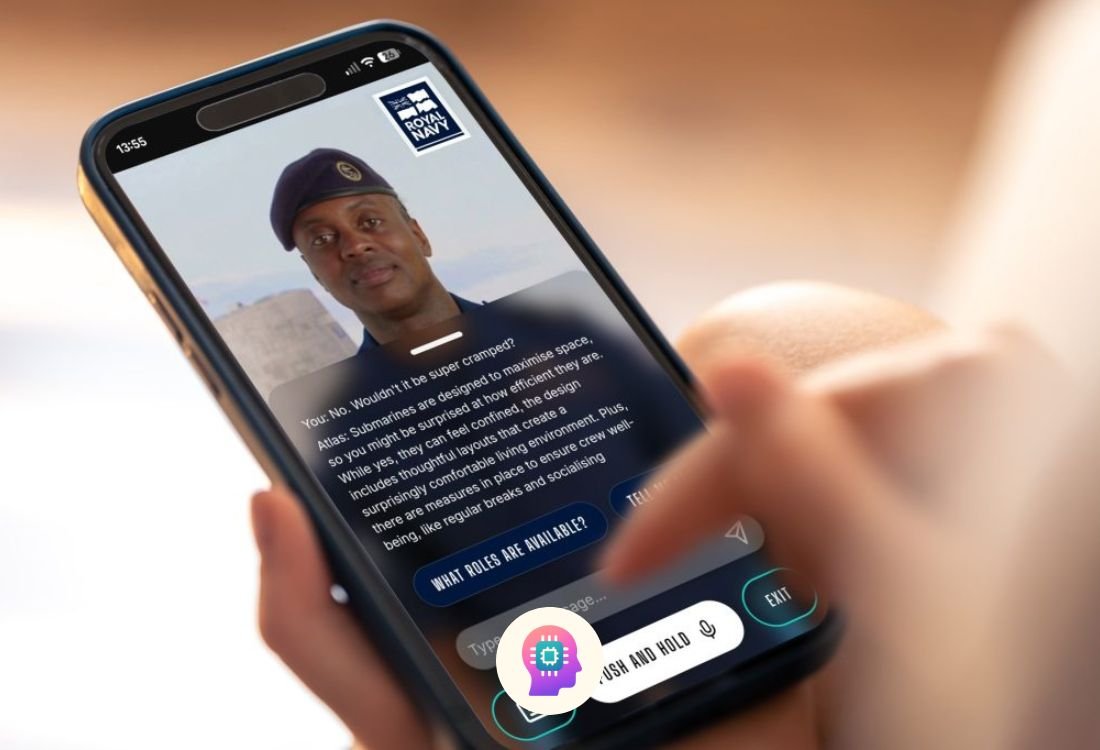
The Royal Navy has taken a significant step in modernizing its recruitment process by introducing a real-time AI-powered avatar named Atlas. This move highlights how artificial intelligence is increasingly being used not just as an experimental tool but as a practical solution to real operational challenges. By placing AI at the first point of contact, the Navy aims to reduce administrative pressure on human teams while offering faster and more engaging support to potential recruits, especially those interested in highly demanding roles such as submarine service.
Atlas is built on a large language model and is designed to interact naturally with candidates who are exploring careers in the Royal Navy. Instead of relying solely on traditional text-based chat systems, this AI avatar brings conversations to life through voice, visuals, and contextual media. The shift reflects a broader understanding that younger audiences often expect more immersive and responsive digital experiences when seeking information or making career decisions.
Why the Royal Navy Turned to AI
Public sector technology projects are often criticized for slow execution and unclear outcomes, but the deployment of Atlas is rooted in clearly defined performance goals. The Royal Navy needed a scalable way to manage a high volume of recruitment queries without overloading human staff, particularly for roles that require extensive explanation and careful candidate screening. Submarine service, known for its unique working conditions and lifestyle demands, generates a large number of detailed questions that traditionally consume significant recruiter time.
Before introducing the avatar, the Navy had already tested the effectiveness of AI through a text-based assistant. This earlier system laid the groundwork by proving that automation could deliver both efficiency and candidate satisfaction at scale.
Performance Data Behind the Decision
The text-based AI assistant, developed in collaboration with WPP Media’s Wavemaker, was eventually upgraded into a full large language model supported by retrieval-augmented generation. Over time, it handled more than 460,000 queries from over 165,000 users, achieving an impressive satisfaction rate of around 93 percent. More importantly from an operational perspective, it reduced the workload of live recruitment teams by approximately 76 percent.
In addition to easing staff pressure, the system generated close to 89,000 expressions of interest, demonstrating that automation could expand the recruitment funnel rather than limit it. These results gave the Royal Navy the confidence to invest in a more advanced and visually engaging interface, leading to the creation of Atlas.
How the AI Avatar Works
Atlas is not built on a single-vendor solution but instead operates within a carefully coordinated multi-partner ecosystem. Wavemaker guided the overall strategy and conversational design, ensuring the AI was trained on accurate and relevant recruitment information. Voxly Digital developed both the front-end and back-end systems, while Great State, the Navy’s digital agency, provided additional support.
What sets Atlas apart is its ability to deliver multimedia responses. When candidates ask about life on a submarine, for example, the avatar can provide spoken explanations, on-screen text, and supporting videos or quotes from serving personnel. This layered approach helps address common concerns more effectively and keeps users engaged for longer periods.
The system is also designed for integration. Atlas is being trialled at recruitment events and connected directly to the NavyReady app and the Navy’s enterprise CRM platform. This ensures that candidate interactions are not isolated but become part of a continuous digital journey.
AI as Support, Not a Substitute
Despite its advanced capabilities, the Royal Navy is clear that Atlas is intended to augment human recruiters rather than replace them. The focus is on using AI responsibly to handle repetitive, low-value queries, freeing up human staff to concentrate on candidates who are more likely to progress through the recruitment pipeline.
Senior officials have emphasized that this approach allows recruitment teams to provide better support overall, offering human interaction where it matters most while ensuring that basic information is available instantly at any time. The trial of Atlas reflects a broader test-and-learn mindset, where new technologies are evaluated carefully before being scaled further.
A Model for Mature AI Adoption
From a broader AI industry perspective, the Atlas initiative demonstrates a measured and data-driven approach to generative AI adoption. Instead of starting with a complex avatar, the Royal Navy began with a simpler text-based system, validated its effectiveness through clear metrics, and only then expanded into a more resource-intensive visual interface.
The result is an AI-assisted recruitment framework that filters routine questions efficiently, improves candidate engagement, and allows human recruiters to focus on meaningful interactions. As governments and large organizations continue to explore AI in 2025, the Royal Navy’s experience with Atlas offers a practical example of how thoughtful implementation can deliver real operational value while maintaining human oversight and trust.